|
PWSR Toolkit Home > Designate > Funding Process

What about funding?
Along with designation typically comes federal funding meant to aid in implementation of the Management Plan and protection of the values for which the rivers are designated, the Outstandingly Remarkable Values (ORVs). The amount of this funding varies, but in previous years designated Partnership Wild and Scenic Rivers (those predominantly running through privately, rather than federally owned lands) have been considered fully funded for the last few years. Though funding is not automatic, any funds from the NPS need to be added to the NPS budget. Requests should happen in preparation for the NPS "Greenbook," which is the detailed budget request from the Department of the Interior.
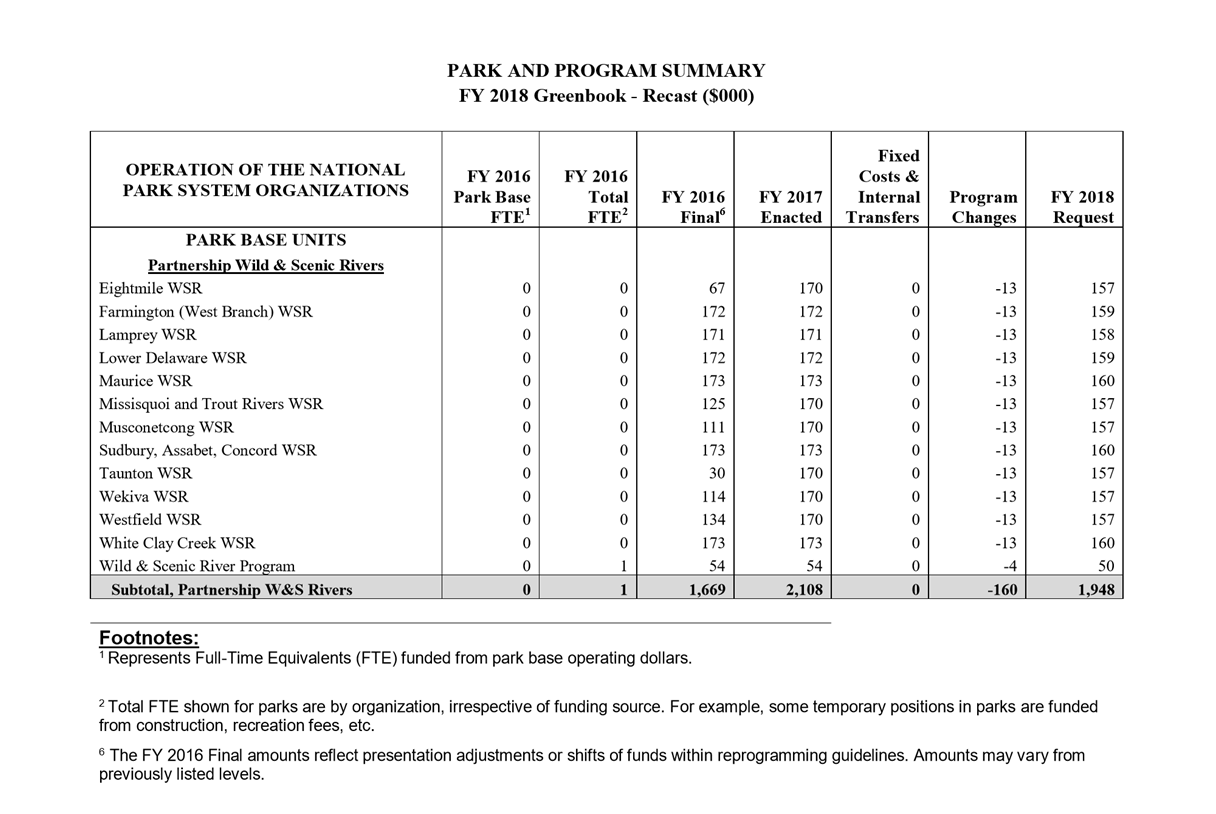
According to nps.gov, the National Park Service develops a budget each February for the next fiscal year, which starts October 1. The NPS budget—published in what they call the Green Book—defines goals and objectives and the funding necessary to accomplish them. The NPS budget is rolled up into the budget for the Department of the Interior and then with the rest of the Executive Branch and submitted to Congress for its review and approval.
The FY (Fiscal Year) 2017 Greenbook and FY2018 Greenbook section on PWSRs are available. A digital copy of the Greenbook can be found on the NPS Budget webpage and goes back to FY2002.
Generally, lobbying Congress is not permitted by employees of the National Park Service. The NPS can request funding for PWSRs in their budget, but that is all. Partnership Wild and Scenic River Committee members have been working together for years to advocate for funding for Partnership Wild and Scenic Rivers, and to fully fund NPS budget requests for WSRs. This is predominantly done through discussions with Representatives and Senators, through Dear Colleague Letters and with a PWSR White Paper. Funding is also part of the mission of the Wild and Scenic Rivers Coalition and is part of the discussion during their annual Hill Week.
The Dear Colleague Letter is official correspondence sent by a Representative or Senator to other members of Congress. It may be circulated for many reasons but is usually stating an opinion about a bill or measure and asking for support (or opposition) to a bill. Congressional representatives from states with PWSRs will often start the process of circulating a PWSR Dear Colleague letter each year requesting signatures of support from other members of Congress. Examples of a Dear Colleague Letter the House and the Senate are available.
Along with this Dear Colleague Letter, a white paper on PWSRs is typically circulated. This White Paper is a way to ask for full funding for the PWSRs and to show the difference between the funding levels written into the River Comprehensive Management Plans and the actual appropriations from Congress and in the NPS budget.
PWSR advocates have had the following notable achievements:
- On October 1, 2014, Northeast Regional Director Mike Caldwell published the first PWSRs policy paper.
- In the FY2017 Department of the Interior (DOI) Budget, the Obama Administration put in a budget request for a $439,000 increase for PWSRs as part of a broader program to "Support New Areas and Critical Responsibilities". Congress passed this increase which was specifically directed at newly designated rivers to bring them up to the base operational budget.
How is funding used?
Any funding to Partnership Wild and Scenic Rivers goes a long way and is supplemented by the partnerships and volunteers that manage designation locally. Post-designation Management Councils draft workplans each year. At the end of each year the work plan is reviewed, and a list of highlights of accomplishments is provided to the NPS. Partnership Wild and Scenic Rivers have all been funded by a Cooperative Agreement, usually between the National Park Service and a non-federal entity, typically a non-profit organization such as the study sponsor. This organization becomes the Fiscal Agent for the funds. More information on Cooperative Agreements may be found on NPS.gov or Grants.gov. Director’s Order #20 provides the directive for how the NPS enters into Cooperative Agreements. An example of a Cooperative Agreement for a Partnership Wild and Scenic River is available.

Funding received is managed by the post-designation Management Council made up of locally appointed representatives, and budgets and expenditures are subject to vote by the local, post-designation management council. Other designated rivers have used these funds to hire local staff support (a Committee Coordinator), and protect and enhance ORVs in some of the following ways (though no Management Council is bound or limited to these uses):
- improved river access for recreation including safe steps for anglers, boat launches, or boardwalk construction
- boater trail and recreational maps
- studies of and best management practices for stormwater management
- small grant programs providing grant opportunities for local organizations to provide education about or protection of ORVs
- biological studies monitoring water quality (through chemical and physical, geomorphological, macroinvertebrate, mussels, or fish) or vernal pool and wetland studies
- use and economic impact surveys
- historical and archaeological assessments
- conservation easements
- river-themed music and arts festivals
- invasive species management
- natural resource inventories
As one can see, Wild and Scenic designation management councils utilize funds for the betterment of the community and the designated rivers. Project prioritization for funding will be set by the local Management Council and will focus on those projects which educate about or provide protection for the ORVs. Decision-making about how funds will be used post-designation are made by the local Management Council. Please see the Study section of this toolkit (How does a Study Committee Form?) for the options for how a post-designation PWSR management council may be formed and staffed. The council will design and adopt a working budget as the Study Committee did at meetings with valuable input by local citizens and key community partners.
To find out more, please see the Designation Benefits page.
Topics in the Designate Section
|